Augers
Auger flights for dry drilling, piling and site investigation.
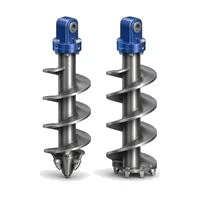
An auger is a spiral tool that lifts soil to the surface as it turns, with no drilling fluid. It is used in soft to medium ground for piles, investigation holes and shallow wells. With no mud, water or compressor needed, auger drilling is simple, clean and quick.
Types of auger
- Sectional flight augers — 1–2 m sections joined together to reach the required depth. Used for geological and shallow holes.
- Hollow-stem augers — samples can be taken, or other tools run, through the centre. The auger stays in the hole and supports the walls, which is useful in site investigation and when installing monitoring wells.
- Piling augers — short, large-diameter augers on a kelly bar or piling rig. They bore the hole in stages, lifting out the spoil.
- Rock augers — fitted with hard teeth for dense clay, stony ground and soft rock.
- Hand and powered earth augers — for fence posts, tree planting and small building jobs.
Sizes and connections
Augers range from a few dozen millimetres to more than 1500 mm in diameter. Sections connect to each other and to the rotary head with hex, square, threaded or pin connections, depending on the rig. When buying, make sure the connection suits your rig.
Heads and teeth
The auger head cuts the ground and wears fastest. Flat cutters suit soil and clay; conical carbide teeth suit stony ground and soft rock. A centre pilot keeps the auger running straight. With replaceable teeth, the auger itself lasts a long time.
How to choose
- Ground. A wide-pitch flight for soft clay and loam; a heavy-duty flight with rock teeth for dense and stony ground.
- Diameter and depth. The hole size sets the auger diameter; the depth sets the number of sections.
- Rig power. A large-diameter auger needs high torque. Going beyond what the rig can turn slows the work and damages the equipment.
Limitations
In waterlogged sand and running ground the hole walls may collapse as the auger is withdrawn. These conditions need casing, hollow-stem augers or mud drilling. In solid hard rock a bit or down-the-hole hammer is used instead of an auger.
When you get in touch, give us the diameter and length you need, the ground type, your rig model and the connection type.