Water well drilling rigs
Rotary and down-the-hole hammer rigs for artesian and process water wells.
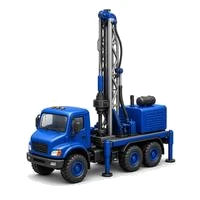
Water-well rigs sit on a truck or crawler chassis and can drill rotary with fluid or with a down-the-hole hammer. The key figures are depth rating, torque and compressor output. This section is for drilling contractors, farms and builders who want to start their own drilling or grow their fleet.
Drilling methods
Mud rotary. The bit turns while the mud pump circulates fluid down the hole to lift the cuttings. This is the main method in soft sections of sand, clay and gravel. The rig needs a mud pump and mud pits alongside.
Down-the-hole hammer (DTH). A hammer at the bottom of the hole breaks the rock with compressed air, and the air carries the cuttings up. It is the fastest method in hard rock such as limestone, sandstone and granite, and needs a powerful compressor.
Combination rigs can do both, which helps where soft and hard layers alternate.
Chassis types
- Truck-mounted — fast on the road and quick to move between distant jobs.
- Crawler — goes where there are no roads, through mud and in the mountains; needs a low-loader for transport.
- Trailer-mounted — a compact, relatively low-cost option for shallow and medium depths.
Key figures
A rig's capability is set by its hoisting capacity, torque and depth rating. The figures are indicative and depend on the model and method:
| Class | Depth rating | Hoisting capacity | Hole diameter |
|---|---|---|---|
| Light | 100–200 m | 6–12 t | up to 300 mm |
| Medium | 200–400 m | 12–25 t | up to 400 mm |
| Heavy | over 400 m | over 25 t | 500 mm and more |
For DTH drilling, compressor pressure and air volume are key too: deeper, larger holes need more of both.
Choosing a rig
- Depth and diameter. The typical wells in your area set the rig class. It pays to allow some spare capacity.
- Rock. Soft sections need a strong mud pump; hard rock needs a compressor and hammer.
- Terrain. Road conditions and distances between jobs decide the chassis.
- Service. Access to spare parts, tooling and maintenance directly sets your downtime.
What else you need
Besides the rig, getting started usually takes drill pipe, bits, a DTH hammer and button bits, a mud pump, a compressor and welding equipment. We can work out the package with you for your workload.
When you get in touch, tell us the depth and diameter of the wells you plan, the rock in your area, and whether you want to buy or hire.