Pile drilling rigs
Auger and kelly rigs for cast-in-place piles.
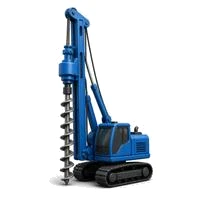
Piling rigs bore the holes for cast-in-place (bored) piles: a hole of the required diameter and depth is drilled, a reinforcement cage is lowered in and the hole is filled with concrete. These piles carry the loads of high-rise buildings, bridges, flyovers, industrial plants and retaining walls through weak soil down to firm strata.
The rigs deliver high torque to bore large-diameter holes quickly and plumb. They usually run on crawlers to move around the site, and the mast folds down for transport.
Drilling methods
Kelly drilling. The tool — a bucket, auger or rock bit — hangs on a telescopic kelly bar. Each time it fills with soil it is lifted out and emptied. This is the most flexible method for large diameters and depths. In unstable or water-bearing ground the hole walls are held by temporary casing or bentonite slurry.
Continuous flight auger (CFA). A long auger is screwed to full depth in one pass, and concrete is pumped through its hollow stem as it is withdrawn. The hole is never left open. The method is fast, with little vibration or noise, which suits work next to existing buildings.
Displacement piles. A special tool pushes the soil aside instead of removing it. The ground around the pile is compacted and there is almost no spoil to haul away.
Key figures
A rig's capability is set mainly by its torque, maximum pile diameter and drilling depth. The figures below are indicative and vary with the model and set-up:
| Class | Torque | Pile diameter | Drilling depth |
|---|---|---|---|
| Light | 60–150 kN·m | up to 1200 mm | up to 30 m |
| Medium | 150–250 kN·m | 1500–2000 mm | 40–60 m |
| Heavy | over 250 kN·m | 2500 mm and more | 60–90 m and more |
Crowd and pull-back force, main winch line pull, operating weight and transport dimensions matter too.
Choosing a rig
- Ground conditions. Sand, clay, gravel and rock call for different tools and torque. The groundwater level decides how the hole walls will be supported.
- Pile diameter, depth and count. These set the rig class; the programme sets the output you need.
- The site. Plot size, access roads, ground bearing capacity, height limits (power lines, under bridges, indoors) and distance to neighbouring structures all count.
- Transport. The rig travels folded on a low-loader, so its dimensions and weight must suit the roads.
Work sequence
- Setting out the pile position and centring the rig.
- Drilling the hole, with casing or bentonite where needed.
- Cleaning the base and checking depth.
- Lowering the reinforcement cage.
- Concreting bottom-up through a tremie pipe.
- Extracting the casing and moving to the next pile.
Write to us about choosing, buying or hiring a piling rig for your project. Give us the pile diameter, depth and count and the ground type, and we will suggest a suitable option.