Horizontal directional drilling
Laying pipes and cables under roads and utilities without open trenches.
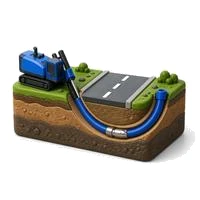
Horizontal directional drilling (HDD) lays water, gas and sewer pipes and cables under roads, railways, rivers or buildings without trenches. The rig is set up at one end of the route, and the pipe is pulled underground along a pre-planned line to the other end.
Where it is used
- crossings under roads, railways, streets and pavements;
- crossings under rivers, canals and irrigation ditches;
- parks, landscaped courtyards and historic areas where the surface must not be disturbed;
- bringing water, gas, sewer and telecom lines to existing buildings;
- dense urban areas where trenching is risky because of existing services.
Advantages
- Asphalt, pavements and lawns stay intact, so there is nothing to reinstate.
- Traffic keeps moving and neighbouring buildings keep working.
- Long crossings are finished much faster than by open trench.
- Little spoil to dig and haul, and a small site footprint.
Stages of the work
- Route design. Existing buried services are located from records and with a cable locator, and the crossing depth and bend radius are calculated.
- Pilot bore. A drill head with a slanted face and a sonde enters the ground. Using a tracking system, the operator follows its position, depth and heading at all times and steers it along the design line.
- Reaming. Once the pilot reaches the exit point, a reamer pulled back through the hole opens it to about 1.2–1.5 times the pipe diameter, in several passes for large sizes.
- Pull-back. A pre-welded pipe string is attached behind the reamer and pulled into the hole.
Bentonite fluid is pumped in at every stage. It holds the hole walls, carries out cuttings and eases the pull-back.
Pipes and capacities
Most crossings use polyethylene (PE) pipe: pressure pipe for water, gas and sewer, and ducting for cables. Steel pipe is pulled when needed. The achievable diameter and length depend on the rig and the ground. The figures are indicative:
| Rig class | Pull-back force | Pipe diameter | Crossing length |
|---|---|---|---|
| Small | up to 10 t | up to 225 mm | up to 150 m |
| Medium | 10–40 t | 400–630 mm | 300–500 m |
| Large | over 40 t | 1000 mm and more | 1000 m and more |
What to watch for
- Existing services. Records of cables and pipes along the route must be obtained from the utility owners.
- Ground. Clay and sand are easy to drill. Coarse gravel, cobbles and rock need special tooling and raise the cost.
- Site space. The entry side needs room for the rig and fluid system; the exit side needs room to lay out the pipe string straight.
- Permits. Crossings under roads, railways and rivers are usually agreed with the bodies that own them.
When you get in touch, give us the crossing length, the pipe type and diameter, the obstacle and what you know about the ground. Photos of the site or a sketch help if you have them.